I don't usually post on weekends because I'm trying to be a family lady (not a "Family Guy"!) but I just wanted to wish every one a lovely Father's Day today:)
Thank you very much for reading Paul's "being a stay at home dad" entry last week. It became the most popular entry on this blog ever! I think that many mums enjoyed reading it as well as dads, because they could feel understood by one of the guys.
Paul was a really great 'stay at home dad' for two and a half months. I have a particular way of doing my house work and thought I wouldn't be able to let someone else do these things, but I could totally trust Paul and could concentrate on my work. He's not staying at home now, but I think he still is the best dad and the best husband...although I'm a bit biased :P
Those two and a half months were a really great time for us as a family. If I just left home to go to work, I wouldn't have been able to know what was happening inside the house. Although I was just in the study and hiding (!) from Nico, I could hear he was having a great time with his daddy and Paul was trying his best, especially when Nico was being a bit difficult. Sometimes I thought that Paul could just ask me for help, but he didn't want to interrupt my work. He did such a great job.
Maybe I didn't really understand, but in some ways I thought it was a bit easier to be a good father than to be a good mum. At least in Japan, dads only see kids a couple of hours a day (if at all) and on weekends, so they can just be nice and have fun with the kids. Kids can also behave well for the guys, because they don't see them as often too. But I was pretty impressed that Paul had the energy to be a great dad the whole time, even when he had all day, 5 days a week looking after Nico. Paul was really enjoying spending time with our little fella.
Now I feel really sorry for Paul, that he has to leave Nico to go to work. Paul really misses Nico at work (and of course we both miss each other heaps too). At the same time, I just feel how lucky I am that I can stay with Nico all the time. This experience has made me realize that.
I am so happy that Paul is my son's dad. I will make sure he will have a great father's day and I hope all the other dads have a great day too.
with love,
Allie

Sunday, 6 September 2015

Friday, 4 September 2015
The attractive TENUGUI world –TENUGUI history
For the last two weeks on Fridays, I wrote about how I got interested in TENUGUI and my TENUGUI making experience in Japan. Today I will write about TENUGUI history. Some of this information is also on my website at nuno and stitch, but I think it's so fascinating that I wanted to share it here too, as well as a little about my own history with TENUGUI.
The history of TENUGUI dates back almost 1300 years. They used to be made from hemp or silk and were mainly used for religious rituals. Back then, Japan imported cotton from China, making it an even more luxurious commodity than silk. About 400 years ago Japanese people started to cultivate their own cotton. Cotton kimono and cotton TENUGUI became very popular. In those days, many people used TENUGUI when going to the public baths, to cover their head from dust, or as a sweat towel.
As TENUGUI became more popular, people started to care more about the designs too. There was a TENUGUI design competition called "Tenugui- Awase" and a special dyeing technique called "Chusen" was developed to create colourful TENUGUI.
When I grew up, my family used TENUGUI just as hand towels. They were usually a pretty plain mameshibori (navy dots) pattern or had newspaper or insurance company names on them. (Those companies often used TENUGUI as a novelty). But now TENUGUI have changed to become something much more attractive. There are so many colours and designs! Some of them are so artistic that you can just put them on your wall for decoration.
TENUGUI have been much loved by Japanese people for a long time. It’s handy. It dries quickly and it’s hygienic. It's very versatile and easy to store. The more you use it, the softer it gets. You can also enjoy the changing colours after washing it. It would be lovely if they are loved by people in Australia too!
With love,
Allie
 |
| image from Wikipedia |
The history of TENUGUI dates back almost 1300 years. They used to be made from hemp or silk and were mainly used for religious rituals. Back then, Japan imported cotton from China, making it an even more luxurious commodity than silk. About 400 years ago Japanese people started to cultivate their own cotton. Cotton kimono and cotton TENUGUI became very popular. In those days, many people used TENUGUI when going to the public baths, to cover their head from dust, or as a sweat towel.
 |
| image from Wikipedia |
As TENUGUI became more popular, people started to care more about the designs too. There was a TENUGUI design competition called "Tenugui- Awase" and a special dyeing technique called "Chusen" was developed to create colourful TENUGUI.
When I grew up, my family used TENUGUI just as hand towels. They were usually a pretty plain mameshibori (navy dots) pattern or had newspaper or insurance company names on them. (Those companies often used TENUGUI as a novelty). But now TENUGUI have changed to become something much more attractive. There are so many colours and designs! Some of them are so artistic that you can just put them on your wall for decoration.
 |
| image from Wikipedia |
TENUGUI have been much loved by Japanese people for a long time. It’s handy. It dries quickly and it’s hygienic. It's very versatile and easy to store. The more you use it, the softer it gets. You can also enjoy the changing colours after washing it. It would be lovely if they are loved by people in Australia too!
With love,
Allie
Thursday, 3 September 2015
Hello! Musubi-Tie-Pin

I've been waiting for this time for so long – the time I can
introduce these cute bow ties to you! These colourful bow ties are
not just cute, but help people in need and are valuable in many ways.
Only one in the world
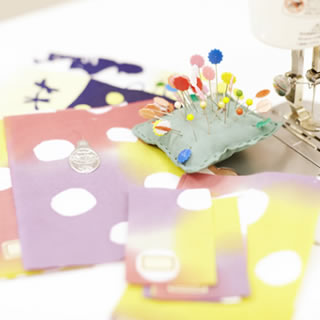
These bow ties are made with the offcuts of TENUGUI, so when I
order these from Japan, I cannot really choose the patterns. If I order 10, I
will get 10 different bow ties. Once each one is sold, I can never
get the same one again. That makes these more special and unique!
Helping others
People with disabilities, who work in a welfare office in Tokyo,
sew these bow ties one by one. If you look at these closely, you’ll see
the beautiful sewing and craftsmanship. In making these, they can
also develop and diversify their skills, enabling them to make a wider
range of products.

Admiring Japanese tradition and craftsman’s skills
A part of the money from this project also goes to the
"Ancient craftsman foundation”, which helps training in craftsmanship in
Japan. In purchasing this product, you are also helping to ensure that
traditional Japanese craftsmanship is handed down to the next generation.
This bow tie comes with a clip, so you can put them on pretty
much everything and anything. You can also swap this clip with another pin or
your hair pin too. If you get one of these, all of your family can
use it, not just as a bow tie, but also as a hair accessory or a brooch!
I hope you like it:)
With love,
Allie
Wednesday, 2 September 2015
My favourite things -vintage dresses
I used to go to this shop in Windsor. They have a deal - if you get two vintage dresses, you get one for free. So I always thought, why would I get just one or two? I always got three ;) Thanks to that deal, my vintage dress collection became quite big…

I wasn’t really a vintage clothing fan when I was in Japan. I thought that it was strange to wear something that somebody else had already worn…well I have a big sister, so I always had to wear second hand clothes anyway and was probably sick of it :P There are so many clothing shops in Japan and I had a couple of favourite brands, so I never had any trouble finding clothes that I liked.Now there are many international clothing labels in Australia too and there are lots of nice clothing shops. But when I first started to live here, I found it difficult to find unique clothing in Australia. Every shopping centre seemed to have the same shops, like Sportsgirl, Just Jeans, Country Road. If I bought clothing from those shops, it was pretty likely that I would see someone else wearing the same clothes in town. You know that strange feeling?So I started to buy clothing only when I went to Japan. But then one day, I saw a very fashionable girl in Fitzroy...and she was wearing a vintage dress! The design was a bit old fashioned, but because of that, it was also very unique. I loved the modest-girl look of vintage clothes too.If you go to vintage clothing shops, you know that there will be no two things that are the same. Once you miss the chance to buy something you like, you can never get it again. It’s like some kind of fate to ‘meet’ your favourite vintage clothes. Sometimes you might even love everything about an item, but the size is just not right.

When I began to buy vintage dresses, I was very surprised that all those dresses had Japanese labels and care instructions. I guess they were imported from Japan at some point. No wonder always the size matches my body! I like to wear those things over in Japan too, because no one wears things like that there. I think my mum finds it a bit interesting that I dress just like how she used to dress though.The other good thing about these vintage dresses is that they often have buttons on the front, so it’s easy to breast feed. A few of my favourites don’t have buttons, so I've put them away in a box for now, but I’m really looking forward to wearing them again when Nico grows up a little bit more!With love,Allie
Tuesday, 1 September 2015
Spring!!
It’s ‘officially’ spring! When I see all the flowers are blooming, I get so excited. However I can't stop wearing my ugg boots yet, nor turn off the heater either. When does ‘real’ spring start??

Spring starts pretty dramatically in Japan. Once the Sakura (cherry blossoms) start blooming, the long and cold winter ends. Japanese people love Sakura. It’s everywhere! They love it not only because it’s beautiful, but also it represents some of the Japanese virtues.
They say the colder the winter is, the more beautifully Sakura bloom and I think that's true. When it's a pretty warm winter, the colour of the Sakura is not as beautiful as in the cold winter years. So Japanese people tend to think that when people have hard time, they can be more successful.

Also they love Sakura because it has such a short life. It tells us that all things are in a constant state of flux and nothing is permanent. You don’t have to worry too much about what you have now.

I know many Australian people want to see Sakura in Japan and I’m often asked when is the best time for Sakura in Japan. It’s really difficult to tell because every year is a little bit different. However, if you go to Japan during the last week of March or the first week of April, you will definitely be able to see Sakura somewhere in Japan.
Although I do recommend going to Japan to see Sakura, you can also enjoy Sakura in Australia too! There is a Cherry Blossom Day in the Dandenong Ranges. I couldn’t find the schedule for this year, but it’ll be around September 20th. Or you can have this new Cherry Blossoms and Java Sparrows TENUGUI and enjoy a spring Hanami (flower viewing) party at home ;)
With Love,
Allie
Monday, 31 August 2015
Being a stay at home dad
Hello everyone, I'm Paul - nice to virtually meet you all! Well, some of you might feel like you know a bit about me already - Allie sometimes mentions me in her blog and when she does it's always something nice...well, one of her many talents is seeing the best in people, so I'm very especially grateful for that :P

The first thing I want to say is how proud I am of Allie - hopefully you all have a sense of what a wonderful and caring person she is from this blog and she is genuinely all that and more in person. Her new business, nuno and stitch, reflects this - attention to detail, always doing her best and consideration and care for others are central to her character and I'd like to thank each and every one of you for supporting her and us.
Allie has kindly agreed to let me jump on her blog to share a little about my experience over the last two and a half months. For the ongoing followers here and our friends and family, you're probably already aware that I've been lucky enough to be a stay at home dad over this time. Well, what an amazing time it's been! I've been able to be a central and everyday part of Nico's growth and development, but I think I've grown and developed almost as much.
The last two and a half months have been the happiest and most wonderful time of my life...and also the most challenging. When I got extended leave from my work, there was a bit of a view among my friends and colleagues that there would be a bit of R&R involved. I think I even started to believe this myself! I'm a pretty lazy guy by nature, so two and a half months of just having to look after the little fella sounded, at least during the "down time", kinda relaxing...until realised there was no down time!
Nico is a beautiful, amazing, happy little kid and the absolute joy of our lives. He's also a never-ending ball of wriggling energy who needs to be monitored the whole time he's awake...and even when he's not awake. Is this the same for all 10 month olds??? Okay, dads can feel free to shrug their shoulders here, mums can feel free to roll their eyes...
Here's some things I didn't realise before, but now understand at least a little bit:
- I didn't realise how difficult it would be to make dinner, wash clothes, do the dishes, clean the house or do anything much while Nico was awake;
- I didn't realise the exhaustion I'd also feel as soon as he went to sleep and hence the difficulty with all of the above tasks even when he was sleeping;
- I didn't realise that his "two hour" naps were almost never two hours;
- I didn't realise how much carrying 10 kg (and growing) around half the day would exhaust me physically;
- I didn't realise that I'd look forward to afternoon tea time so much with my parents...almost every day;
- I didn't realise that thinking of something different to make for dinner every day would require every ounce of the brainpower I had left;
- I didn't realise I'd do this much realising!
I only did these things for a couple of months or so, but I hope I understand all this a little better now. It's the hardest job I've ever done...but also by far the most rewarding! I'm so glad that I got the opportunity to learn and appreciate all the things involved in looking after the little guy five days a week. So, thank you to Allie, to my mum and to everyone responsible for caring for someone else - you all do an incredibly amazing job! And thanks to my work for giving me this chance to understand all this a bit better.
Allie has been working extremely hard while I've been looking after Nico too. It's a huge thing to start your own business and she's done it as only she can, in the most thorough, efficient and thoughtful way possible. I'm sure it'll be even more of a challenge for her when I'm back at work, but I hope that with my new understanding I'll get home a little earlier, will make the dinner a little more often and will generally have more genuine empathy about what's been going on during her day.

Finally, when I was thinking about what to write in this entry, I had an idea that I might include a quick and easy recipe or two that I've made during my time off - I've always liked cooking, but it was more as a hobby than as an everyday necessity for the family (and there's quite a difference - another realisation). I think this entry might be more than long enough already though, so with Allie's permission, I might post a collection of recipes in a subsequent blog entry in a couple of weeks or so.
The other thing I wanted to write about was some tips for stay-at-home dads, but I'll hold off on these for now too.
Oh and thanks for reading "stitch by stitch" everyone, I hope this entry has been interesting. Allie's blog entries always come from the heart and I really love reading them (actually, I'm always the first person who gets to read them), so I hope you don't mind me crashing the party this time and maybe occasionally in the future.
Ah, I nearly forgot - Father's Day is coming up, so have a great day dads! There's some really great presents at nuno and stitch for the blokes (my personal favourites are the business card holders and the sports towels) and there's some more things that are super cool (but I can't tell you about) being announced soon. Stay tuned!
Cheers,
Paul

The first thing I want to say is how proud I am of Allie - hopefully you all have a sense of what a wonderful and caring person she is from this blog and she is genuinely all that and more in person. Her new business, nuno and stitch, reflects this - attention to detail, always doing her best and consideration and care for others are central to her character and I'd like to thank each and every one of you for supporting her and us.
Allie has kindly agreed to let me jump on her blog to share a little about my experience over the last two and a half months. For the ongoing followers here and our friends and family, you're probably already aware that I've been lucky enough to be a stay at home dad over this time. Well, what an amazing time it's been! I've been able to be a central and everyday part of Nico's growth and development, but I think I've grown and developed almost as much.
The last two and a half months have been the happiest and most wonderful time of my life...and also the most challenging. When I got extended leave from my work, there was a bit of a view among my friends and colleagues that there would be a bit of R&R involved. I think I even started to believe this myself! I'm a pretty lazy guy by nature, so two and a half months of just having to look after the little fella sounded, at least during the "down time", kinda relaxing...until realised there was no down time!
Nico is a beautiful, amazing, happy little kid and the absolute joy of our lives. He's also a never-ending ball of wriggling energy who needs to be monitored the whole time he's awake...and even when he's not awake. Is this the same for all 10 month olds??? Okay, dads can feel free to shrug their shoulders here, mums can feel free to roll their eyes...
 |
| Father's Group on Friday-my bro, brother in law and me (and the kids)! |
Here's some things I didn't realise before, but now understand at least a little bit:
- I didn't realise how difficult it would be to make dinner, wash clothes, do the dishes, clean the house or do anything much while Nico was awake;
- I didn't realise the exhaustion I'd also feel as soon as he went to sleep and hence the difficulty with all of the above tasks even when he was sleeping;
- I didn't realise that his "two hour" naps were almost never two hours;
- I didn't realise how much carrying 10 kg (and growing) around half the day would exhaust me physically;
- I didn't realise that I'd look forward to afternoon tea time so much with my parents...almost every day;
- I didn't realise that thinking of something different to make for dinner every day would require every ounce of the brainpower I had left;
- I didn't realise I'd do this much realising!
I only did these things for a couple of months or so, but I hope I understand all this a little better now. It's the hardest job I've ever done...but also by far the most rewarding! I'm so glad that I got the opportunity to learn and appreciate all the things involved in looking after the little guy five days a week. So, thank you to Allie, to my mum and to everyone responsible for caring for someone else - you all do an incredibly amazing job! And thanks to my work for giving me this chance to understand all this a bit better.
Allie has been working extremely hard while I've been looking after Nico too. It's a huge thing to start your own business and she's done it as only she can, in the most thorough, efficient and thoughtful way possible. I'm sure it'll be even more of a challenge for her when I'm back at work, but I hope that with my new understanding I'll get home a little earlier, will make the dinner a little more often and will generally have more genuine empathy about what's been going on during her day.
Finally, when I was thinking about what to write in this entry, I had an idea that I might include a quick and easy recipe or two that I've made during my time off - I've always liked cooking, but it was more as a hobby than as an everyday necessity for the family (and there's quite a difference - another realisation). I think this entry might be more than long enough already though, so with Allie's permission, I might post a collection of recipes in a subsequent blog entry in a couple of weeks or so.
The other thing I wanted to write about was some tips for stay-at-home dads, but I'll hold off on these for now too.
Oh and thanks for reading "stitch by stitch" everyone, I hope this entry has been interesting. Allie's blog entries always come from the heart and I really love reading them (actually, I'm always the first person who gets to read them), so I hope you don't mind me crashing the party this time and maybe occasionally in the future.
Ah, I nearly forgot - Father's Day is coming up, so have a great day dads! There's some really great presents at nuno and stitch for the blokes (my personal favourites are the business card holders and the sports towels) and there's some more things that are super cool (but I can't tell you about) being announced soon. Stay tuned!
Cheers,
Paul
Friday, 28 August 2015
The attractive TENUGUI world - CHUSEN
Last week on Friday, I wrote about how I became interested in TENUGUI. This week, I’d like to share my TENUGUI making experience in Japan:-)
When I started to learn about TENUGUI, I was of course also interested in how TENUGUI were made. Originally I had thought they were machine printed like other fabrics, handkerchieves and those sorts of things, but was surprised to learn that they were hand dyed.
 |
| measure out each TENUGUI and put a dye-resistant paster on each section |
I found a TENUGUI making workshop in Tokyo, so I booked it and went there with my old university friend. Our instructor of the day was a young girl. I didn’t ask her background, but I was pretty impressed that a young Japanese girl was succeeding in the traditional Japanese TENUGUI making method of “CHUSEN”. (or maybe she was brought up with it…)
 |
| make a guard with special paste around each pattern to prevent the dye from flowing into other areas |
At the start, we watched a short video about TENUGUI making. More typical looking old craftsmen were showing their work and techniques. I could see how experienced they were and how much pride they took in their work. We have a word to describe a well-trained craftsman in Japan - it’s “shokunin”. When Paul and I were once talking about the word “craftsman”, we found that we had quite different images for the meaning, but then I found that the right translation for ‘shokunin’ is not really ‘craftsman’. I came across this explanation:
 |
| pour the dye using special pot called "Yakan" or "Dohin" |
— Toshio Odate
I realise now that the people I saw in the short video were not just ‘craftsman’, but ‘shokunin’.
 |
| our instructor was a young girl! |
 |
| washing off the dye-resistant paste |
 |
| this MANGA explains how to make CHUSEN TENUGUI A typical Japanese way of learning! |
Temperature, humidity, and the timing of when the ‘shokunin’ stops pouring their dye, all these small things can make a difference in each TENUGUI. That’s why each TENUGUI is unique!
 |
| soft line of CHUSEN TENUGUI |
 |
| the colour bleeding is also its charm |
If you find a very cheap TENUGUI, it might not be made by this traditional Chusen method. I have often seen TENUGUI at a 100 yen shop (like a dollar shop!) in Japan. If you kinda like the pattern and want to use it without worrying about how to care for it, this can be okay.
But if you want to get a traditional TENUGUI, make sure you check the back of it. The back of machine printed TENUGUI is plain, but for CHUSEN TENUGUI, you cannot really tell which is the front or back, because the both sides are dyed. This is another difference between Chusen and other dying methods, like screen printing - all these details make me appreciate TENUGUI and the work of the shokunin masters more and more.
 |
| the colour gradation |
But if you want to get a traditional TENUGUI, make sure you check the back of it. The back of machine printed TENUGUI is plain, but for CHUSEN TENUGUI, you cannot really tell which is the front or back, because the both sides are dyed. This is another difference between Chusen and other dying methods, like screen printing - all these details make me appreciate TENUGUI and the work of the shokunin masters more and more.
 |
| this is NOT CHUSEN |
Do you want to learn a little bit more about TENUGUI? I will write about the history of TENUGUI next week!
With love Allie
Subscribe to:
Posts (Atom)